Gays in Primetime -- A Special Investigative Report: Part IIOn ABC’s Ugly Betty, a young boy sings and dances on a crowded subway, performing the role of Tracy Turnblad for his parents with broad gestures and diva-esque asides. A subway passenger mutters “fairy” under his breath, prompting the boy’s father to come to his son’s defense. And thousands of young people in the American television viewing audience see a stunning reflection of their own reality, their own sense of differentness.
It’s a powerful but rare image on network television. A recent Gay and Lesbian Alliance Against Defamation (GLAAD) report on GLBT representation on the five broadcast networks found only a handful of GLBT characters in current scripted shows, and in the last decade gay network visibility has actually fallen. In 2008, there are networks that don’t have a single scripted GLBT character appearing in any of their shows, and no network has a series GLBT lead. In this two-part series, AfterElton.com investigates why television may be failing at presenting representative gay images, images that provide an inspiration and mirror many in our community desperately need, and to which much of straight America is rarely exposed. In Part One, the Entertainment presidents of the five broadcast networks said they want more GLBT diversity on their airwaves and expect to do better. But they also said that ultimately the responsibility lies with writers to create those characters. Here in Part Two we speak to those creators, both gay and straight, from some of the most successful shows currently on television to explore: What hurdles may be preventing GLBT characters from being created? How can those hurdles be overcome? And why does it matter that they succeed? What we’ve found is a nuanced web of mixed messages, real obstacles, some inaccurate assumptions – and a fair amount of indigenous Hollywood fear. But there are also successes where the power of a creator’s vision, and the blinders they wear to potential impediments, combine to allow the creation of fascinating gay characters able to make a universal connection. Sex and the Gay Eunuch Gay differentness is an issue that eventually comes down to sex. That’s a topic that neither the American public nor television does a rational job of discussing. And while sex and romance are a critical part of creating the conflict at the heart of any drama or comedy – it’s also the precise point where gay characters confront the most roadblocks. The issue of gay characters and sex comes into high relief where it collides with the network internal censors: Standards & Practices. These internal watchdogs, set up by the broadcast networks, police content to ensure it complies with “legal, policy, factual and community standards.” In practice, this often means separate and unequal treatment for gay vs. straight intimacy. Greg Berlanti, showrunner for ABC’s Brothers & Sisters, Dirty Sexy Money and the recently debuted Eli Stone, recalled for this article his own early tussle with S&P. While showrunner on the 90’s WB teen soap Dawson’s Creek, Berlanti had to “threaten to quit” to force a same-sex kiss – for then groundbreaking gay teen character Jack McPhee – past S&P objections and onto the air. When two years later, Jack got kiss number two, Berlanti reports, “We literally had someone from Standards & Practices on set with us” timing the intimate moment to make sure it didn’t go too long.
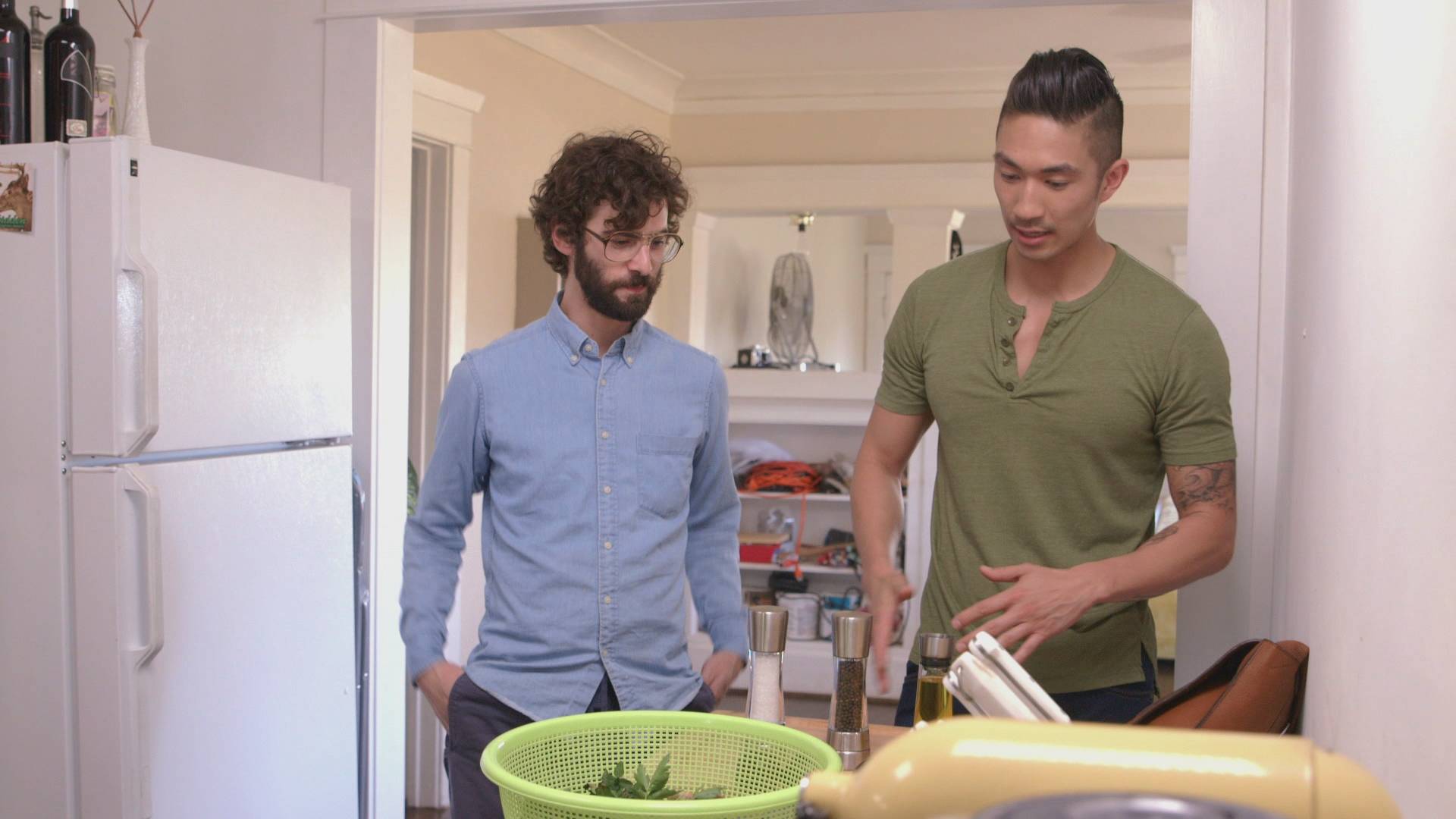
Greg Berlanti (left) and the groundbreaking kiss on Dawson's Creek Pushing Daisies showrunner, Bryan Fuller, similarly found his creative vision bump up against the S&P guard dogs. As creator and showrunner for Wonderfalls three years ago on FOX, Fuller created the character of Sharon Tyler, an ambitious, Republican lawyer who was also a closeted lesbian. When it came time for that character to have an onscreen kiss, Fuller told AfterElton.com “we were told explicitly that we could not have two women’s lips connect, and we would have to cut away. … Standards & Practices would not allow a same-sex kiss.” But it wasn’t just FOX. In 2002, Fuller wrote the teleplay for an NBC remake of the Stephen King horror classic Carrie. In one scene, a female character gives CPR to another female character, and the creators were informed by S&P that they could not have the “lesbian kiss” on screen. Fuller remembers being stunned. “We were like – it’s mouth-to-mouth resuscitation!” But there are more subtle ways that sex – or the lack thereof – ends up undermining gay characters. With so few gay characters appearing on network television, they often end up on a series as an isolated queer character existing in a world of only straights. Not only does this not reflect reality, in the fictional world it leaves gay and lesbian characters cut off from the romantic and sexual conflicts that help propel plotlines forward and create viewer interest. It’s also much easier for those solitary gay characters to just disappear. On Fuller’s current ABC show, Pushing Daisies, Olive Snook, the supporting character played by Kristin Chenoweth, was originally conceived as a lesbian. But Fuller said that during development the character was de-gayed in the interest of potential romantic involvement with the male lead, thus creating conflict for the male and female leads’ romantic chemistry. Submitted by on Tue, 2008-04-08 21:15. |
![]() Recent Comments
Recent blog posts
|