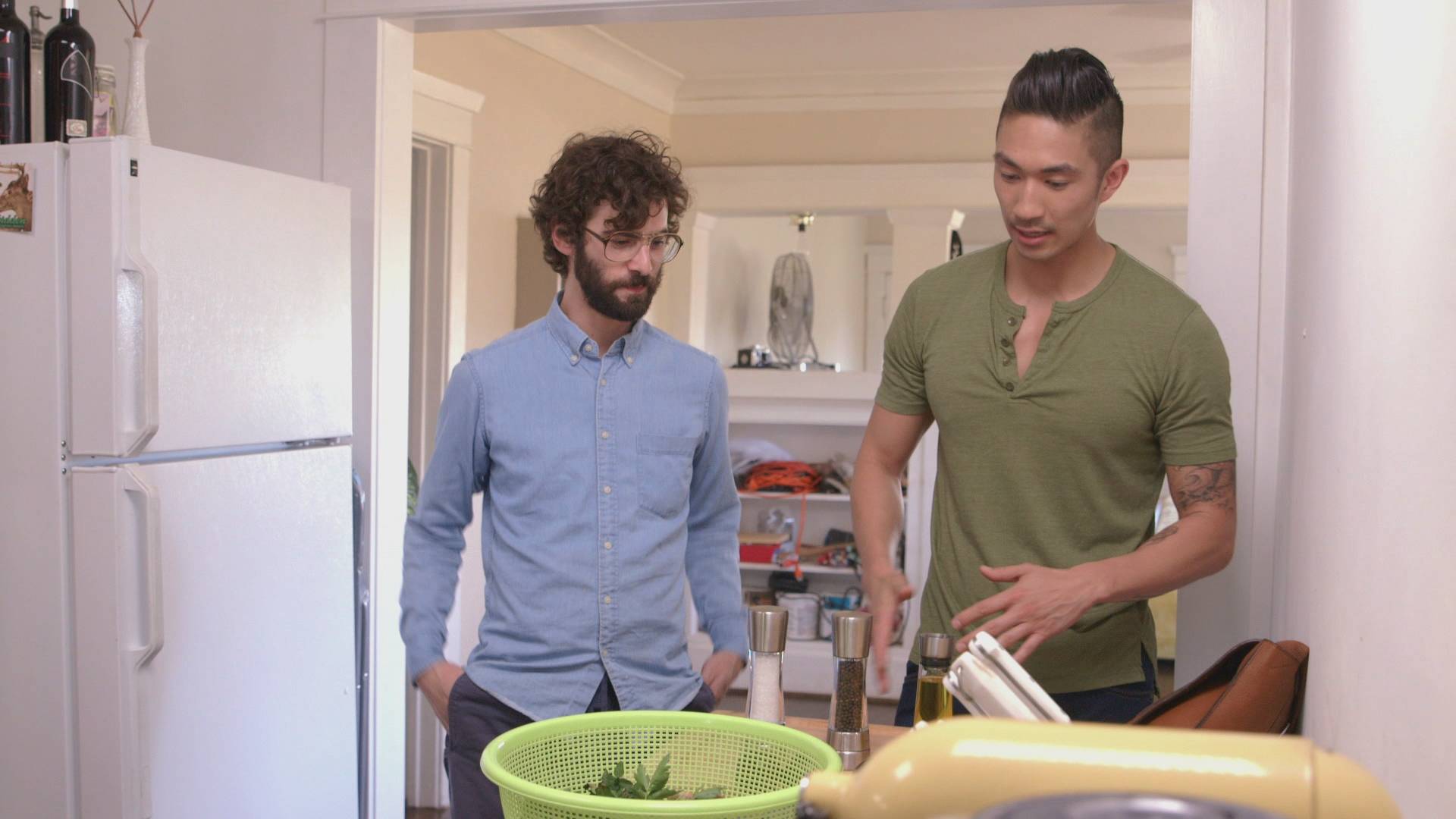
Jose Pablo Cantillo and Gene Farber
In the new issue of TV Guide, William Keck shares a few details about Virtuality, a science fiction pilot that Fox is considering adding to their schedule. Why should you care about yet another new sci fi show? Because this one will be the first U.S. science fiction show to include actual gay characters. Take that Star Trek!
At this summer's Television Critics Association tour, I had a chance to speak with Virtuality's head writer and executive producer Ronald D. Moore (who you probably also know from his various gigs on Star Trek and, of course, Battestar Galactica). I also chatted with Fox's President of Entertainment Kevin Reilly about the show his network might be picking up. Both gave me some scoop, plus Moore opened up about science fiction writers' — including himself — failure to put gay characters in their various worlds. We also chatted about why that has happened and what needs to change.
Virtuality, which is set in the near future, is about a spaceship on a ten year deep space mission and it just happens to include a gay couple played by Jose Pablo Cantillo and Gene Farber. About the couple and their relationship Reilly told me:
It's a great relationship. It's a very straight forward, honest portrayal. They are front and center. The pilot's story centers around the corporation backing the whole thing and [they] want the [gay couple] to get married. They are the only unmarried couple on the ship and there is a proposal in the [episode]. And the one guy is saying "Are you just doing this because of the corporation? You never wanted to get married before. " And the other guy is saying, "No, this the push I needed. So there is an engagement in the pilot.
Ronald D. Moore, Kevin Reilly

Photo Credit: Matthew Imaging/FilmMagic and Getty Images /Jean Baptiste Lacroix
More below the fold including the Cylons' sexuality and how Moore feels about not including gay characters before now.
In a separate conversation Ronald Moore added:
They’re a married gay couple and they were just included when we were coming up with the core cast of characters. Michael Taylor and I were talking about it and I think it was his idea and we just – he goes through part of the concept of how that group of astronauts were chosen initially, that they were – it’s hard to tell you about without giving away the whole concept of it, but they weren’t just a group of astronauts that went through the traditional vetting astronaut process.
They were all sort of symbols for specific reasons for this particular mission and for almost PR reasons ... they were put on the ship and the [gay couple] sort of struggle with that role of – "Is that the only reason we are here?" kind of thing. But they’re professionals in their own right. They have a complicated sort of storyline of what they’re willing to show.
When asked how prominently the gay characters will be featured, Moore said:
It’s pretty much an ensemble because in that series we got 12 people in the universe and so they’re all kind of like on the same table because that’s our world. We’re not going to have a lot of guest stars. We’re not going to really have a big world to play in other than these virtual realities, so I don’t know that they really fall into a category second lead or anything like that. It’s really an ensemble.
I also asked Moore to address science fiction's failure in general to include gay characters.
We’ve just failed at it. It’s not been something we’ve successfully done. At Star Trek we used to have all these stock answers for why we didn’t do it. The truth is it was not really a priority for any of us on the staff so it wasn’t really something that was strong on anybody’s radar. And then I think there’s a certain inertia that you’re not used to writing those characters into these dramas and then you just don’t. And somebody has to decide that it’s important before you do it and I think we’re still at the place where that’s not yet a common – yeah, we have to include this and this is an important thing to include in the shows. Sci fi for whatever reason is just sort of behind the curve on all this.
And given that he has worked on some of the biggest science shows of the past twenty years, how does that failure make Moore feel?
It makes me guilty. I always feel guilty when these questions come up because it’s something that I don’t do and I haven’t done enough of and I hope I do do, but I haven’t really done it. Okay, in Virtuality I’ve started to do it, we talk about it – hopefully we execute that well in Caprica. I don’t know. It’s a hard thing to – I don’t know how to quantify the why of it, you know, why does this happen like this? Because certainly there’s no shortage of gay writers in science fiction rooms, so we’re all sort of part of the conversation together.
As to why science fiction has failed to create those characters, Moore said:
I think some of it has to do with [how] certain science fiction deals with action/adventure sort of roles and action/adventure sort of archetypes and traditionally gay and lesbian characters are not part of those archetypes. So when you are doing a version of Die Hard on the Enterprise like we did in Next Generation, there’s not usually the gay or lesbian characters part of that equation Which doesn’t mean that of course none of these characters can’t be that, but it doesn’t usually like – oh, yeah and then there’s usually the computer guy and there’s this guy and you’re not usually thinking in that template and television writers and film writers think in templates.
We think a lot about, oh, let’s do Casablanca. Oh, let’s do this. And oh, let’s do our version of that kind of story. And unfortunately gay and lesbian characters are not generally part of those archetypes from which we draw, so already you’re not in the headset of incorporating them into your world because they’re not part of the things that you’re using as a foundation to draw upon. It’s a problem.
When I told Moore how much I loved Battlestar Galactica, but that as the seasons went by and so many important social issues were explored except gay ones, I grew frustrated, he admitted:
I would not argue with you at all. It’s certainly something we did not succeed in.
Michelle Forbes, Tricia Helfer
Battlestar Galactica did deal some with female bisexuality, most notably in the television movie Battlestar Galactica: Razor which included a relationship between Admiral Caine (Michelle Forbes) and one of the Sixes (Tricia Helfer). Asked about the Cylon's sexuality, Moore said:
We sort of always talked about the Cylons being basically bisexual in all formats. They didn’t really have gender roles within the twelve models kind of thing, but we never really played that idea out so I don’t know if we ever really established that as part of the mythos, but that was something we sort of talked about.
We pretty much established that some of the Sixes, there was the Six that was in a relationship with Admiral Caine so we know that that’s part of some of the Sixes, whether that means that applies to all the Six models, we just never got into that depth, that kind of detailed stories of them.
Moore is also executive producing the BSG spin-off Caprica. Might that have any gay or lesbian characters?
We’re in the process now of starting to think about what Caprica the series will be and what the storylines are and it is something that we’re talking about in our sort of nascent writers’ room where we have some people together and we’re just talking about what it could be and we are talking about it as an active thing, like okay, how can we work in gay, lesbian and bisexual storylines into this and that – it’s just not there yet, but it is part of the discussion.
Hopefully, Virtuality will get picked up and along with Caprica, American science fiction shows will finally move into the 21st century.
Moore would be shocked, shocked, I tell you...
...to discover that there was homosexuality in Casablanca! Hell, doesn't the movie end with Rick and Captain Renault walking off into the fog, the "start of a beautiful relationship"?
Besides, what's the point of utilizing an "archetype" if not to do some kind of spin on it?
That said, I'm looking forward to Virtuality; sounds very interesting.
Check out my blog: http://radicalsexy.blogspot.com/
Lt. Gaeta was totally gay!
So according to Moore being
So according to Moore being gay & being an action/adventure-type are incompatible??? I guess if there's a need for hair stylists, fashionistas, & florists in space, then we'll see gay characters b/c they fit the "archetype"?
Talk about clueless.
Star Trek especially was about envisioning a world BETTER than our own, a world where the status quo in the present wasn't good enough. For that, we got, amongst other things, a black captain (Deep Space 9) & a woman captain (Voyager). But apparently a better world didn't include gay people being incorporated into society.
One of the major themes in Battlestar Galactica is about exposing problems in our world. Terrorism, religious fanaticism, & torture are some of the issues the show has dealt with. But apparently homophobia isn't something worth addressing.
Character Archetypes
The only reason gays aren't a part of the character archetypes that Moore mentions is because people like him have made it a point to specifically exclude us over the years. How many great warriors of the ancient world were bi or gay for example (Alexander the Great, you out there)? Sometimes when people like Moore talk I get so infuriated because they say unbelievably stupid things and don't even realize how stupid they are!
Oh dear
Pffft, give the man some slack, would you? When talking about "Archetypes" he seems to have something else in mind than some of the commentators here. Have a look at this site to get an impression of archetypes used in our media today.
Using Archetypes when creating a story, you simply go along the lines of: "Ok, we take the computer nerd forced to act like the action hero. The nerd will use his nerd-ness to overcome the henchmen while the action chick helps him out and exchanges snappy remarks." As you can see, most of the archetypes used to describe the characters (e.g. Nerd, action chick, minion, hero etc.) have nothing to do with sexual orientation. It's not "the gay nerd" or "the lesbian action chick" and neither it is "the straight nerd" or "the straight action chick". So, basically, all Mr Moore sais is: Since being gay is no defining characterstic as, for instance, "Nerdiness" or "One-Liner-spitting Hero", writers do not consider it when creating characters.
Additionally, there are no real plot-scenarios, where Homosexuality comes in handy. Sure, you can make the usual "I love my gay, dead son"-Aeseop, singing the song of tolerance etc. but apart from that, what other kind of "gay" storyline is there? So, since there is no "gay" plot per se, it is disregared as a story, as well.
In the end, homosexuality only comes into play when you create character interaction and the good old love-shtick (Will they/won't they, Flirting, Longing etc.). Regarding this case, Mr Moore stated "You’re not used to writing those characters into these dramas and then you just don’t" I mean, Jesus, there are enough gay writers who do not know how to write and handle gay relationships, like, at all, so why should we expect a straight man to do it? To pick up another quote from his interview: If you do not have to do it and if you do not feel confident enough to pull it through convincingly, why do it at all? Hell, ask any person about his work attitude and he will probably give you the same answer. All the more I am glad that Mr Moore took the reaction of his fans as an impulse to incorporate gay relationships.
Don't Excuse Mediocre Writers who Exclude Gay Characters
...
I was not excusing anybody. My intention was to clarify Mr Moore's usage of the word "Archetype" and to express that I really like the explanation of why he did not include gays. Again, I must ask: If you do not have to do it and if you do not feel confident enough to pull it through convincingly, why do it at all? It's not an excuse, it's just basic work attitude.
You ask for help and advice
First of all, it isn't "if you do not have to do it." If you are a writer, especially if you are writing a television program that wants to appeal to as much of a cross-section of the population as possible, then it is incumbent upon you to have that show reflect the diversity of society, and that includes gay men and women. (Indeed, one of the great things that I admire about General Hospital: Night Shift is its cast of characters, one of the most diverse I think I've ever encountered on a TV series, soap opera or not.)
Second, if you do not feel confident that you can pull it off, you ask for help and advice. Being a writer in Hollywood, surely you should know other gay writers; and if you don't, you contact the Gay & Lesbian Writers Committee of the Writer's Guild of America to provide input and consultation.
Finally, Psionycx is right in his comment below regarding "archetypes" and gay inclusion. We're not not asking for a full-on sex scene between two guys in space, à la James Bond and Holly Goodhead in Moonraker, though that would be nice.
Writers--good writers--have been bending and altering archetypes throughout history: isn't Sherlock Holmes basically the nerd-as-hero? So why is difficult to transpose a sci-fi or action character, traditionally assumed to be straight? All it takes is a casual comment or observation.
There's a great moment in the 1990 film Internal Affairs: two cops (Andy Garcia and Laurie Metcalf) are sitting in a car; a hot woman walks past; Garcia watches her, drool practically coming out of his mouth; then he--and the audience--notices that Metcalf is watching her with the same desire. Nothing is said, just a look of recognition between them. That's all it takes to establish a gay character and alter the archetype. Of course, if that occurs in a television series, the expectation is that in future episodes, there will be a deepening of that character beyond just a glance.
Check out my blog: http://radicalsexy.blogspot.com/
The "gay" archetype trap
Thanks Joseph. That's the point I'm struggling to get across here.
The reason there's so much reluctance to use gay characters is because writers often erroneously believe that gay characters must be used in "gay" storylines. There was an interview with some sci-fi writers here a few months back where they commented that they explore "alienation" in other ways. As if homosexuality is all about being alienated!
These narrow-minded writers therefore tend to view gay characters as limited. Possible stories include coming out, facing discrimination, fatal disease, etc... The kind of unapologetic sexuality that you see on Torchwood, where nobody bothers to justify the gender of their partners, is still too foreign to most U.S. writers.
Why couldn't a starship security officer be gay? In the beginning of Star Trek, The Next Generation the job was occupied by a woman after all, and that was in the 80's. So it's not as if you can argue that the archetype requires a heterosexual male to fill the role. Ditto for ship's doctor, ship's counsellor, ship's engineer or ship's captain.
The only limiting factor is the perception that a gay character's story must be about their gayness. Since ship's hairdresser and ship's interior decorator are off-camera roles these writer's have felt that there's not place for a "gay" archetype in the story.
It offends me because the notion is that "gay" is an archetype on it's own and therefore can only be used in stories where that archetype is needed. The notion of a character based on another archtype, such as the stern ship's captain or the tough ship's security officer, could happen to be gay as an aspect of their character is not something that they really seem to grasp.
the gay character in recent Andromeda Strain
And that's a good start
I Liked His Comments
Great Interview, Mike.
I can't fault Moore too much.
He's being incredibly honest about what's generally goes on in the minds of mostly straight TV writers -- it just doesn't occur to them that gays are heroes too. It's only just recently, with the launch of all of these specialty gay sites that we're really breaking down the stereotype of what gays are. Or broadening it to include jocks, soldiers, mountain climbers and jedi knights.
Obviously Moore recognizes things need to change and is finally doing something about it in main-stream TV.
You see, I disagree about what Moore is thinking
The problem is, and always has been, the idea that being "gay" is an archetype unto itself, rather than just being an aspect of a character.
Nobody ever thinks of "straight" as being a predominant archetype. When you consider all the Star Trek characters to date for example, their heterosexuality is simply a given. It's not used to define them, but it's not absent either. Often single-episode romances or references to past relationships are very casually added just to provide some depth to the characters beyond just firing phasers and spouting Treknobabble.
There has been talk about introducing gay characters into the Trek universe in the past. Most recently with Malcolm Reed on Enterprise. But it never went anywhere, despite the fact that Reed had no pressing heterosexual romance that was essential to the storyline that might preclude him being gay.
Again, the issue is almost that people like Moore make too big a deal about the idea of gay characters. It's as if they'll have to come up with "gay storylines" for the characters that would detract from the rest of the plot. This creates an unecessary barrier to the introduction of gay characters because it's believed that their story will have to be about being gay.
So yes, I'm a little embittered by the years of neglect, and cycnical about promises for the future. Hopefully things will be better going forward, but I'm going to need to be convinced first.
Afterthought
While it is certainly good to point out the nonexistant inclusion of gay characters by the writers, I also want to point out the lack of gay actors. I am not against straight people playing gays, but why are there not gay actors to portray gay characters? Examples are Brokeback Mountain, Will&Grace and, yes, Virtuality.
As I already said, I am conflicted on that matter: Naturally, I am very glad, that heterosexual men publically thwart homophobia by playing gay characters and sometimes even have physical contact with other men, not to mention the hotness a straight actor introduces (yes, sometimes I am that shallow). On the other hand, I would really love to see a gay actor playing a gay man, because ... well, just because.